Showing posts with label review. Show all posts

Thursday, June 10, 2010

Abandon Hope, All Ye Who Enter Here: "DOOM 3" Review

Game: DOOM 3 (Yes, you do have to capitalize the title consistently. It bugs me, too)
Platform: PC, Mac, Xbox
Genre: First-Person Shooter / Survival-Horror
Developer: id Software
Publisher: Activision
Release Date: August 3, 2004 (NA), August 13, 2004 (EU)
Players: 1 (2-4 online, though enterprising modders managed to boost this paltry number up to 16)


It’s been 17 years since the release of the very first DOOM, a game that arguably has a claim to being one of the most historically significant and influential of all time. Don’t believe me? Just think about everything DOOM did for the industry. It popularized and cemented the first-person shooter genre into gaming culture, so much so that most FPS’s for years afterward would be referred to as “DOOM clones”. It helped spark the fires of the violent video games controversy that lives on even to this day, no matter how often Joe Lieberman fails to secure a presidential nomination. It gave rise to the early days of video game piracy, back when torrents and file-sharing programs took the more primitive form of floppy disks swapped amongst kids in the back-alleys of school like an illegal drug. It was one of the first games to inspire a legitimate mod-making community, rife with unauthorized pop culture insertions from The Simpsons to Ghostbusters. And of course, it had that undeniably awesome theme music, one of the most iconic tunes in gaming history. I could go on, but suffice it to say that the original DOOM (and to a lesser extent, it’s sequel DOOM II) has a laundry list of milestones and achievements, and the industry owes it a debt that can never be truly repaid.


Ah, those were the days…

It’s been five years since the release of DOOM 3. And, it, umm…it...it looked real nice at the time, I suppose. I, err…I guess that’s it, really.

OK, let’s be honest here, there’s not much more that the so-called third game in the series can do but look upon its glorious ancestor in awe-struck splendor. And considering the many degrees in which the FPS genre has evolved since 1993, for there to be no noteworthy hallmarks upon the résumé of this game is, quite frankly, rather pitiful. There have been multiple takes upon whether this truly diminishes the impact of the game, though; it was, indeed, given a strong reception upon initial release despite its lack of innovation. But personally, that’s not even what galls me about DOOM 3 the most (although that is most certainly a part of it). It’s that, somewhere in time, starting from the moment it began development to the moment it hit store shelves, DOOM 3 stopped being…well, DOOM.


The best part of DOOM 3. Yes, really.

I’m going to go out on a limb and proclaim that you might have played a video game or two at some point in your life. I’ll presume further that there’s a very good likelihood that, for reasons clearly iterated in the first paragraph of this review, the original DOOM may have been one of them. And if you’re the type of person who fancies themselves a “gamer”, then I sure hope that is the case; if not, then I would suggest doing so right this second before even considering using that term to describe yourself again. Seriously, right now. I’ll wait. This article isn’t going anywhere.


Okay, you finished? Good, now assuming once more that your memory hasn’t decayed to the point of complete incompetence, you almost certainly possess a grasp on what the DOOM experience is composed of. The very mention of the title should give rise to visions of speedily running about in mostly well-lit, occasionally open-ended areas swarming with fiendish, over-the-top-cartoony monsters. They stand between you and where you need to be…and they also happen to be standing on the receiving end of your shotgun. As the corpse pile up, shells are spent, and totally radical MIDI-ized metal riffs wail in the background, masking the screams of your fallen foes, you vaguely recall a brief mention of some kind of story that instills method to this madness. Then you immediately cease to care and continue your odyssey into pure, unmitigated violence against the forsaken hordes of Satan.

So upon booting up the DOOM 3 disk, a warning light should flicker on in your head when, right from the beginning of the game, it becomes apparent that it’s going to attempt to have a plot. It touts itself as a re-telling of the tale from the original game, but what was once a brief write-up translating in essence into “Hey, there be demons here. Go kills them.” now takes the form of extravagant cutscenes, featuring characters and dialogue when the need for such a thing clearly does not exist. Among the ranks of the game’s compelling cast are a doctor you know is evil from the second you meet him because he lacks a pupil in one eye and speaks in a voice you might hear from the hidden intercoms at a carnival’s haunted house, as well as a authority-figure-type counselor who the game tries desperately to establish as a fake-out villain, but who clearly isn’t because…well, he isn’t the unambiguously evil doctor.


Seriously, how do you even get hired looking like that? Does “evil cackling” make an attractive feature on the résumé of an aspiring scientist?

As if the cliché-o-meter isn’t full to bursting already, there are also no less than two grizzled, gravely-voiced veteran lieutenants, one of which escorts the counselor with the aid of about six lines of dialogue, and the other of which spends the first half of the game sitting in his office, giving you orders and eating all the Easy-Mac until he remembers that there’s supposed to be a story, at which point he turns evil for the purposes of creating hopelessly non-existent dramatic tension. And then there’s you: a nameless, mute, disproportionately-muscle-bound meatslab of a man who holds no interest or emotion in anything taking place around him. Of course these supposedly interesting new characters and concepts need to be introduced, so whereas DOOM had you pumping lead into zombies by the ten-second-mark, DOOM 3 marks its clear intention to shamelessly integrate the ideas of other, better, and more recent FPS titles by leading you through a lengthy, bloodless introduction scene similar to (i.e. almost identical to) the one in Half-Life. Then again, Half-Life didn’t allow you to murder innocent scientists without anyone else even giving you a weird look in return.


“Yes, can I help you? Wait, what are you doing with that revolver? No, stay back, I…GAAAH!”

Inevitably, of course, all Hell literally breaks loose in the Union Aerospace Corporation facility, and you, the player, have to fight your way out, figuring out what went wrong in the process (spoiler alert: it may have something to do with the evil scientist cackling uncontrollably in the corner of the room). It’s at this point that you expect the balls-to-the-wall action you remember from your nostalgic memories to finally arrive and make the game fun again, but it’s not too much longer before you’re disappointed. This simply isn’t DOOM as you remember it, and while change isn’t inherently a bad thing, you’ll find that the series isn’t so much “changed” as it is “trapped”: sandwiched between the game it’s supposed to be and the game it wants to be.

To be fair, there are some ways in which, for better or worse, DOOM 3 is actually very much the same game you played in 1993. The scientific complex you venture through is rendered in a stunning total of about three different shades of grey (discounting the numerous spatters of red, of course). You stumble across armor, med-kits, and ammo with every alternate step. The level design is standard and linear, only occasionally manipulated in the form of a key-fetching quest or a brain-dead puzzle. The monster designs – many of which are simply monochrome variants of the classic baddies encountered in the old titles – range from only mildy disturbing to downright juvenile when placed in the more realistic context that the game strives for (not to mention one of the bosses – I kid you not – is a former marine general whose torso has been grafted onto tank treads for seemingly no reason).


Skeletons with rocket-launching shoulder-pads and flaming, jetpack-adorned skulls were rad in the early 90’s, but now…?

Furthermore, the AI is as laughably single-minded as it was back in the day, never amounting to more than “run at guy, bite at face”. Even the weapons arsenal is nearly unchanged, plucked straight from the Generic FPS Weapons Handbook 90’s Edition. The only notable deviations in your armory are the series trademark BFG, a demon-slaying plot-MacGuffin known as “the Soul Cube” (don’t ask), and the chainsaw…though really, within the framework of the newly dead-serious story, what a chainsaw is doing on a Martian research outpost is really anyone’s guess.

UAC Employee #1, Mac: Hey, did you get those hydrofusion battery order forms I asked you to mail out? We need those in the lab by Tuesday.
UAC Employee #2, Bob: Uh, yeah, about that…I DID mail them out, like you asked…but there was kind of a mix-up in the post office, and we accidentally ordered about a hundred chainsaws instead.
Mac: Damnit, Bob! First you “accidentally” triplicated the quantity of our shipment of security armor and back-up ammo, then you spent company money on a rocket launcher that we will never , EVER need, and now THIS!
Bob: Well…we could just scatter all that stuff around the base. Y’know, hide it in inconspicuous places, around corners…no one would ever know!
Mac: Yeah, I guess you’re right. No sense in stockpiling all that stuff in some dusty supply room somewhere. And hey, at least you managed to successfully order in those NON-flammable, NON-exploding barrels this time, right?
Bob: Uh, yeah, about that…

But then again, as boring, cliché-ridden and conventional the gameplay may be, it is at least acceptably functional on a mechanical level, and may very well have served as an appropriate springboard towards a no-holds-barred spamfest shooter romp…or at least it could have been, were the classic DOOM elements not attempting to occupy the same space as a survival-horror game.

Yes, DOOM 3 grabs hold of the retrospectively silly notion that the original games were as scary as they were furiously intense and runs with it to the ridiculous extreme. So now, instead of boldly and recklessly charging through open-ended levels filled to the brim with hordes of ferocious demons, the fully-armed space marine finds himself steadily creeping through claustrophobic labyrinths, only occasionally stumbling into the one-odd pitched battle with a single Satanic minion. Meanwhile, the awesomely plagiarized tunes of the classics are replaced by the quote-on-quote “atmospheric” silence of the base, sporadically broken up by the sounds of combat or the periodic cheesy horror-movie-trailer-voiceover courtesy of that evil doctor archetype telling you just how many ways you’re going to die.


“Oooooo, look! Now your screen is reeeeeeed! Are you scaaaaaaaared yeeeeeet? OooooooOOOOOoooo!”

Most notably, nearly every event in the game hinges on cheap scare tactics, a most detrimental fact in regards to combat; seemingly every demon in the game is stationed in place like a spring-board display in a theme park ride, waiting until you cross some form of invisible line before leaping out from behind a door, around the corner or – my personal favorite – an otherwise-empty sliding-door compartment in the wall. Here's a question: why are the bloodthirsty spawn of the Malebolge patiently waiting for passers-by in a fucking pantry? And what the hell were those closets necessary for before the demonic invasion?

Mac: Hey Bob, the atomic collider just malfunctioned. Do you have any spare flux capacitators lying around your office?
Bob: Nah, sorry man…but hey, why don’t you check the metal-shuttered closet in the hallway?
Mac: Y’know, I never did understand why the UAC had these built in. Hell, it seems more like a violation of building code than anything el…dude, there’s just a shitload of board games in here!
Bob: What, really?
Mac: Yeah, who woulda thought? Candyland, Mouse Trap, Stratego, Yahtz…oh my God, fucking Hungry Hungry Hippos!
Bob: Score!

Then of course there’s the darkness. Every last corridor of DOOM 3 is simply flooded with shadows, a fact just as inconvenient to the player as it must have been to the chronically-depressed former employees of the UAC. Seriously, for a facility touted to be at the cutting edge of human knowledge and understanding, nobody there seems to know how to create a productive work environment.


“Look, all I’m saying is, a bigger janitorial budget might improve morale just a little.”

This, in turn, introduces the flashlight mechanic. Yes, we’ve all heard the flashlight jokes, from how a well-funded research facility seems to lack any duct tape to graft the damn thing to your gun to the obvious inquiry of why space marines stationed in a noticeably poorly-lit environment (in the future, no less) wouldn’t be issued weaponry with built-in visual aid…but rather than harp on these fallacies of logic, let’s discuss its harmful ramifications on the actual game, shall we?


Does no one else find it ironic that the lighting effects were one of the most publicized features of DOOM 3’s new engine? Because, y’know, there’s barely any light to begin with?

The goal of the flashlight mechanic is fairly obvious and well-intentioned at heart. By making the player choose between the gun or the flashlight without overlap, it creates a dichotomy between visibility and defensive ability, attempting to induce fear in the process. This works in theory. In practice, however, it’s downright infuriating, for several reasons. For one thing, it’s distressing to leave player success or failure up to the hands of their very natural limitations, i.e. their vision. In other words, it’s one thing to lose in a death-grapple with an imp due to skill, and quite another due to the fact that the player couldn’t aim the chaingun through impenetrable darkness; this is especially true since, as implied earlier, there is isn’t much initial threat from an enemy when you happen to be armed to the teeth and coated in body armor, and thus the sight disability serves as the only real challenge in many confrontations. Also, the aforementioned over-saturation of shadow makes the flashlight essentially necessary to see at all in certain spots, which more or less removes the critical choice from the player. Again there’s a distinction to be made here to the developers: it’s one thing to impair the player’s combat readiness for the sake of horror, but it’s quite another when you create the illusion of choice regarding this impairment. And lastly, it’s just downright clumsy implemented; having to constantly have your thumb hovering over the button while you wait for the game to schizophrenically decide whether it’s going to maintain the quiet integrity of the atmosphere or just throw a cacaodemon at you is annoying, as is the rather awkward animation you’ll constantly witness as you flip back-and-forth from your weapon to the torch. It’s really just a frustrating mechanic from start to finish, and reinforces the belief that the game is attempting to be something that it’s not.

And really, that’s the most glaring weakness of DOOM 3; in attempting to branch out towards a genre almost inverse in style to its roots, it sours the remaining aspects of the source material. Had the developers more consciously chosen to extract the remaining FPS lifeblood from the game and transform it into a purely survival-horror experience, it might have worked; as it stands, the DOOM brand stands averse to the elements that make a horror game function. Compare the hybrid, half-heartedly frenzied horrorscape of DOOM 3 to a true master of the genre such as the Silent Hill series; sure, the former may startle on the first through playthroughs with its one-time funhouse scares, but the latter’s fog-drenched, unsettlingly lifeless environments create an atmosphere of sheer, pulsing dread just from the player picking up the controller…and that’s a game series where you can shoot and have a flashlight on at the same time!


That’s right. James Sunderland is more competent at multi-tasking than a trained space marine.

Even more action-oriented horror gameplay along the lines of DOOM 3’s thought process has been successfully achieved by the likes of Condemned: Criminal Origins, which equipped you, the player, just as well as the psychotic (and shockingly intelligent) foes, making every confrontation a matter of life or death. Here, alas, the predictability and repetition of the game’s handful of scary tricks soon bog it down, forcing it to rely on the shooter elements which, thanks to the terror-emphasis, went sadly underdeveloped.

But I haven’t even mentioned the most obnoxious aspect of DOOM 3: the PDA. Oh, sweet-buttery-Jesus the PDA. You’re granted a free personal-data-assistant as you enter the base; whether this is a free promotion from the station’s gift shop or a simple act of kindness, I really could never tell. It serves little help on its own, but you can upload the files of other employees’ PDAs upon finding them, through what I can only assume is an infrared communications port akin to the Game Boy Color. Of course, you’ll stumble upon plenty of unattended devices as you progress through the decidedly empty base, whereupon you can shamelessly rifle through the audio logs and emails of the deceased. Respect for the dead, who needs it?


“I’ll trade you my breakthrough research notes for your private insurance information!”
BONUS CAPTION: What? IMP is evolving!...Congratulations! Your IMP evolved into HELL KNIGHT!


It’s really nothing more than a variation on the audio logs popularized by System Shock (confirming once more that the game would rather ape innovations of influential late-90’s shooters rather than devise any itself). But whereas other games with such a system like System Shock, Bioshock, and Metroid Prime possessed an interesting plot, shrouded in the cloak of a mystery to be unfolded, I must remind the developers that the only intrigue to the plot of DOOM is exactly how evil the clearly evil scientist actually is, and that the most startling revelation the logs ever unveiled for me was that the UAC seemingly only has one female employee (apparently the feminist movement receded in on itself somewhere in the early 2100s). No, there’s a much more sinister purpose for the audio logs of DOOM 3 than simple story embellishment, and it can be stated in one word: lockers.


The worst part of DOOM 3. Yes, really.

See, the understandably nerve-wracked denizens of Mars clearly figured that something unholy (quite literally, as it turned out) was about to go down, so they decided to store their munitions and medical supplies for safe-keeping within the confines of massive, encoded storage lockers, each with a four-digit entry code. And because nobody thinks to use the primitive devices of pen or paper in the future, the only way anyone recorded these passwords was within the files stored on their PDAs. This means that, in order to be at maximum strength throughout the game, you’ll need to pause the game every time you pick up a new PDA, scroll through the text files and listen to the mind-numbingly dull recordings to find these all-important codes, whereupon you can retrieve the grab-bag of goodies inside the lockers. You can, of course, choose to listen to the audio files whilst still venturing through the facility, rather than simply sitting at the PDA-menu screen twiddling your thumbs like a fool while you pretend to feign interest in Dr. Gripesalot’s thoughts on the new plasma gun’s alpha-wave combustor-core, or Mr. McFussypants’ watercooler gossip about how that dick Jim from accounting stole his best stapler when he wasn’t looking, or whatever…but guess what? If you happen to the miss hearing the actual code from behind the sound of an explosion, or demonic scream…or, y’know, the sound of the game being played, you have to start it over from the top. Most insultingly of all, the lockers themselves are almost never hidden at all, always found a couple rooms away – or, even worse, a few measly feet – from the PDA that holds their passkey, rendering the whole exercise pointless, futile, and a direct affront to my intelligence. There’s simply no excuse for the kind of flow-breaking tedium this system invokes.

Mac: I was thinking of running down to the coffee room for a donut, you wanna…umm, what are you doing?
Bob: Oh, sorry, I was just recording an audio log of my research for the day. Plus I stored all my left-over sponge cake in the locker over there, so I wanted to remember the passcode I set for later.
Mac: That WAS damn good sponge cake. But listen, why’d you record a secret code in the one device that anyone on this base can access without any sort of authorization of their own? And couldn’t you have just written it down on a sticky note and kept it in your pocket or something?
Bob: Well sure I could have, but then how would the player know how to get to it once he’s found his way here?
Mac: YOU DAMN FOOL! WHAT HAVE YOU DONE?!
Bob: Wait, what? WHAT?!
Mac: THE FOURTH WALL! IT’S…IT’S BROKEN!
Bob: Oh god! I’m a MONSTER! AAAAAAAAAAAAAAHHHH!
Mac: AAAAAAAAAAAAAAAHHHHHHHH!!
Bob: AAAAAAAAAAAAAAAAAAAAAAAHHHHHHHHHHHHHHHHHHH!!!

The saddest part is that many of these annoyances can actually be partially avoided by forsaking the single player campaign and jumping online. Mind you, the competitive multiplayer is a joke, nothing more than basic deathmatch with a pathetically small player count (by default, anyway) and the same ol’ dark, cramped map layouts. But when tackling the hordes of Lucifer in online cooperative play (strangely found only in the Xbox version), the attempts to polish the game down into a shorter, more stream-lined experience surgically remove many of the aforementioned hindrances to the fun. There are far more monsters packed in far more open spaces, making for a more action-packed adventure, and the addition of a second player transforms the flashlight from an annoyance to an actually interesting mechanic; one player guides the other through the dark labyrinths, counting on the partner to defend him/her from beasties.

It’s simply a shame that this won’t be the game that will be remembered through the annals of gaming history. Instead, it will be the game that crushed light-hearted, over-the-top monster-slaying fun under mundane concepts, confused gameplay, and cheap scares. People unfamiliar with both first-person shooters and horror games (as I once was when I first played the game, in what seems like eons ago) might enjoy a one-time, mildly-atmospheric march through DOOM 3, but anything beyond that and the game loses its luster, ceasing to be little more than a tech demo.

But in spite of all of that, it’s hardly the worst thing to hold the DOOM name. Why, that would have to be…


…oh God no.

TO BE CONTINUED…

Friday, May 21, 2010

Dustbuster: "Phantom Dust" Review

Game: Phantom Dust
Platform: Xbox (backwards compatible on Xbox 360)
Genre: Err...
Developer: Microsoft Game Studios (with designer Yukio Futatsugi)
Publisher: Microsoft Game Studios (Japan), Majesco (USA)
Release Date: September 23, 2004 (Japan), March 15, 2005 (USA)
Players: 1-2 (2-4 online)


So intent are we, as a culture, to categorize everything that it’s currently difficult for a unqualifiedly “different” form of music, film, or video game to be declared. So when a game like Phantom Dust comes along and creates a hybrid of styles too outlandish in concept to fill any established genre niche, we tend to ignore it, as if it disgusts us by virtue of the way it defies our flawless system of artistic taxonomy. Besides, experiments fail all the time; surely the safe and familiar establishes a better insurance policy for disappointment, right? Alas, the falsehood of this common belief is one of the key lessons I’ve learned in recent years. And thanks in part to recent run-in with a brilliant but infamously overlooked video game title by the name of Psychonauts (which is something I won’t be reviewing here, though perhaps this guy could tell you all about it), I’ve been reminded of just how delightful certain titles can be even when the majority of the populace has eviscerated them from their hearts and minds in favor of Vaguely Sci-Fi-ish Alien Shooter Gore Fest 3 or whatever. And so, I present to you what I feel to be the most unheard-of little gem in my treasure chest of games, Phantom Dust.

But I perhaps I should confess that I stumbled upon this glorious title completely by accident. It wasn’t even a conscious purchase, but a gift, probably one persuaded by its $20 budget price. But Mario-Party-hatred not-withstanding, let it never be said that I am completely opposed to the virtues of chance, because without it I never would have been able to preach the virtues of a game that allows you to, among other things, telekinetically hurl bombs at people, generate flaming swords out of your hands AND make a pact with Mephisto for in-game bonuses (if any of the above premises made you either raise your eyebrows in confusion or pump your fists in a fit of manly excitement, then please, continue reading).

Phantom Dust is not only a very, very fun ride, but it’s also a very, very perplexing one that, even several years later, I still have a hard time describing on a whim. Were I forced to pigeon-hole the game into an official genre title – in accordance with society’s whim to drain the fun out of anything – I would call it something along the lines of an real-time-arena-fighter with competitive trading card game elements. And the truth is, it’s actually a little more complicated than that.


This guy is the protagonist, by the way. Make of that what you will, but at least be thankful he doesn't talk.

The story starts out simple enough: it’s yet another post-apocalyptic scenario with the last remnants of humanity left on the fritz, framed in the styling of surreal Japanese anime. This is no Fist of the North Star, however; in this particular rendition of the end of days, the surviving members of our species have lost all of their memories and been driven deep into the underground thanks to a mysterious, memory-draining (and dare I say, phantom-like?) dust that covers the surface of the Earth. Sure, it’s common for the protagonist of a game to start out with an empty head, but it’s a whole other story when the entire cast is filled to the brim with amnesiacs. In fact, the only memory left that everyone seems to share is of some enigmatic ruins…along with the inexplicable urge to go there. And so you join the ranks of the Espers – those who have learned to concentrate the power of the dust into psychic energy – in order to search the dangerous surface world for clues on the location of the ruins, and eventually unraveling a revelation far more shocking than you bargained for.

Well, that’s all well and good, but how exactly do these trips to the surface pan out in-game? Well…that’s where things get a little tricky.

See, each Esper brings to the surface with them a set of psychic skills, known collectively as an arsenal. These skills gradually spawn in the form of capsules on the battlefield, three at a time, at which point they can be assigned to one of the four face buttons on the controller. These skills are used to combat enemy monsters and beings, each with their own set of skills…assuming, of course, that you have enough energy to use the skill, which regenerates over time but must have its capacity increased by collecting Aura particles, which are also incorporated into the arsenal. Oh, and as a reminder, all of this pans out in real-time.


It's processing the sheer amount of raw data that appears on screen like this that should theoretically give me my OWN psychic powers.

Still with me? Well, then there’s the issue of creating an arsenal prior to charging out on the battlefield. An effective arsenal must strike a perfect balance between offense, defense, and that ever-present white Aura stuff that glues it all together. And with 300+ skills available, it’s easy to get overwhelmed by the sheer amount of options on hand.

First there are your attack skills, with can strike at various ranges (long, medium, or short) and have various patterns (shot in an arc or a parabola, falling from the sky onto your enemy’s head, in the form of a blade, etc.). Then there are defensive abilities that can protect you from the aforementioned attacks, shielding your front, sides, or all around you, or perhaps even sending the attack right back where it came from, among other possibilities. There are skills that boost your stats and skills that decrease those of your foes, or even a skill that allows you forcibly trade your stats. There are skills that erase, stripping the skills right from your foe’s hand or devouring their capsules…but watch out, because the price for many of these abilities might involve erasing so of your own possessions. There are skills that allow you to dash, levitate, teleport, heal, turn invisible, turn invincible (briefly), paralyze, freeze, confuse, distract, summon a precision strike from a satellite-mounted death laser…the list goes on. Hell, there are even skills that allow you to change the rules of the entire game, altering what skills everyone can use, how much damage everyone does, or even just reversing everyone’s analog controls (which inevitably results in everyone drunkenly wandering off cliffs). Oh, and another thing: each skill is divided into one of five classes, and you can only have a certain number of classes in any one arsenal at a time, depending on the size of the arsenal case, dictated by…


…yeah.

Make no mistake, the learning curve for Phantom Dust is not so much a “curve” at all as it is a jagged, foreboding cliff face. But once you’ve grown accustomed to the game’s unique brand of combat, it suddenly morphs from a bewildering experience into an engrossing one; after growing acclimated to the bizarre system, you begin to realize the vastness of possibilities the it presents. Sure, I’ve made my fair share of vanilla “shoot-things-move-until-they-die” setups, but the true fun of the game is getting really creative with the more esoteric skills available.

For the sake of example, I was once able to develop an arsenal that revolved around me boosting my speed to such ludicrous levels that I could dodge most homing attacks by simply running away from them. I’ve created vampiric decks of skills that bolster my health and Aura levels by draining it from my enemies. I’ve made arsenals that focus on depriving everyone of energy so that my weaker, low-cost skills could reign supreme…and, inversely, ones that purposefully boost my enemy’s energy to insane new heights so that I could later use a skill that did damage equal to their Aura levels for one-hit-kills (I call that one “Backstabber”, in case you were wondering). But perhaps my favorite is one that doesn’t even have any attack skills in it at all; the goal is simply to sneak (or sometimes, teleport) into the enemy base, steal or destroy all their capsules, then flee, repeating the process until the opponent completely lacks for both skills and, well, hope. And let me tell you this with certainty: just one victory utilizing such a devious, cerebral scheme is more satisfying than any number of frag kills in any number of generic first-person shooters you could ever play.


Sadly, I can confirm that even in such a brilliantly strategic game, cheese tactics still exist. You wouldn't know from this picture, but you are actually witnessing the Phantom Dust equivalent of a "Zerg rush".

Once you’ve grown addicted to the Dust’s power, and subsequently hooked some of your friends, the skirmishes that unfold are truly a fantastic sight, especially with additional players over Xbox Live (try using the skill that allows you to listen in on the enemy team’s headset conversations…classic). It’s a shame, then, that the single-player campaign – where you must unlock the capacity to even make arsenals and acquire skills in the first place – is such a tedious chore.

The first two or three chapters in single-player are essentially an epic-length tutorial, which is perhaps necessary due to the sheer bulk of knowledge necessary to fully enjoy the game. But even after that, the missions rarely boil down to anything more complex than “go here, kill everything, and come back”. It doesn’t help matters that the various monster types rarely differ in anything other than arsenal setup and health amounts, and that there are a mere seven levels available, only five of which you’ll ever visit on a regular basis. Granted, the levels that exist are brilliantly designed and tie into the surreal, post-apocalyptic setting quite well – ranging from an abandoned mall (that the game’s characters refer to quite certainly as a “palace”) to a true mindfuck of a city where gravity and perspective are flipped by ninety degrees – and the end of each chapter usually has a hulking boss battle to spice things up. Nonetheless, only the joy of testing and fine-tuning new arsenals on the battlefield will carry you through the repetitive scenarios, essentially leaving the burden of having fun on you.

Even worse than that is the underground city that serves as your hub between missions. While there’s nothing inherently wrong with the design of the place, nor the functional aspects of it (namely, the zones where you can buy new skills or edit your arsenals), there IS something wrong with having to play hide-and-seek with mission availability. See, while you’ll get the majority of your assignments from a specific NPC tasked with exactly that job, occasionally he’ll run out of errands for you to run and suggest that you talk to someone else for new quest. And because that someone could be essentially anyone, it forces you to play duck-duck-goose with NPC dialogue boxes until you finally find the guy who will allow to progress the story along. It’s boring, it’s unnecessary, it brings the game’s pacing to a screeching halt, and it kind of makes me want to use my dust-fueled telekinetic powers to detonate the heads of whichever game designer thought that adding a marker on the map telling us who to talk to next was too much.


Like this. (gotta love Scanners, by the way)

But, surprisingly, all of these flaws actually end up fairly irrelevant. In the end, what you pay for in Phantom Dust is its unique gameplay, and the system it developed for that purpose couldn’t be any more perfect. It sets out to found a startlingly new form of in-game combat, both fast-paced and rich in strategy, and accomplishes its goal with flying colors. As stated before, the game was discount price upon release, ensuring a cheap bargain deep at the bottom of your local discount bin; the graphics still look impeccable, despite being a generation behind and five years of age; and the cries of its surprisingly robust underground community have cemented its backwards compatibility on the more modern Xbox 360, so it’s far from too late to enjoy this rare and undeniably unique experience.

There, now maybe somebody other than me will own this damn game.

OHSHITDIDISAYTHATOUTLOUD…

Thursday, January 14, 2010

... : "I’m Not a Fan, But the Kids Like It!" Review

Experiment #: 2304
Subject #: 4305
Artifact #: 001 (Codename Omega)
Purpose: To test the environment in which we hope to scientifically interact with the artifact without risk, and to observe the artifact's effects on an intelligent human being
Medium: Recording
Status: FAILED


[The following recordings were obtained from a device operated by Subject #4305, tasked with performing experiments and research operations on Artifact 001. He was allowed access only to broad data on the artifact in question, knowing not of its more…potent capabilities. These recordings will be studied in turn to observe whether or not the artifact can be studied in a controlled environment with expressed variables.]

[static]

Hello? Is this on? Test…test, one, two…OK…

This recording device will serve as a diary of my progress during my mission. I’ve been advised not to identify my name or who I work for, only recording data that pertains exclusively to my research. My employers are confident that my work could possibly prevent a great deal of pain and suffering from the world, and while I do not yet understand the degree of peril that this mission represents, I’m going into it with an air of caution and scientific sensibility, as I have been trained to.

The mission parameters are simple: to listen and record my findings on an audio CD entitled I’m Not a Fan, But the Kids Like It!, released by a band called BrokeNCYDE. I have never heard of these individuals up until this point, and I fail to see how a single CD could compromise a danger, as I believe my employers described it. Yet if I can somehow identify why this is, and perhaps find a way to avert it, then mankind may perhaps be saved.

To whoever may listen to this tape, wish me luck!

[static]

The cover art of this album depicts a set of four suburban males, attempting emulate both the tropes of "emo" culture as well as befitting the stereotypes of "urban" African-Americans. In addition, the first track of the CD seems to be a composite of creative-commons WAV files shamelessly compiled into an irrelevant, sci-fi-flavored mess, followed by a cliché explosion. Understandably, my hopes for something intelligible and cultured have already been dashed.

The first track began, and suddenly the keyboard meandering was pierced by a pre-pubescent scream. Good Lord…I had no idea that human vocal cords could produce something so abhorrently irritating. Was this, perhaps, why I was tasked to overview this album? Could the leading man of this band possibly be afflicted by a new disease that rots and decays the voicebox?

Whatever the case, the screams continued, overlaid upon singing so auto-tuned that it may as well not be human, but machine. Perhaps…it is. I will be sure to research into the identities of these talentless vocalists ASAP.

This combination of lame keyboards, lamer vocals, and random shrieking continued with nearly no variation for the next three minutes and thirty-six seconds. My hand quickly reached to pause the music at that point, apparently not just so that I could record my notes but out of subconscious drive that had developed in my brain over that time. Intriguing…

Despite my clear dislike of this music, I am devoted to finishing my research. Perhaps something hidden in this mess will provide something of remote use…or, at the very least, will make the music listenable.

[static]

Nothing has changed. The same behavior described in my previous record has continued unopposed for quite some time now. What had at first been mildly amusing as a hilariously terrible novelty has now grown into a worsening repugnance, and I fear I may not have the will necessary to continue. I still do not yet know what danger this record could pose to the world, however, and so must not yet regress my sacrifice.

In my spare time between tracks, in an effort to wash out this befouled recordings from my mind, I have researched the individuals response behind this terrible artifact. They have christened themselves with confusing nicknames, such as Se7en, Antz, and Phat J. The role of Antz, in particular, has become something of a mystery to me, for the liner notes list him as being responsible for “Rockstar beats”. As I fail to understand what they means, I have theorized that it is a cover for the fact that this man has had no true impact in this creation. I propose instead that he was the guy who served appetizers and beverages to the other members in the recording studio lounge.

I have also begun to investigate the lyrical content of this release, expecting that they may form some kind of code that exposes the aforementioned malice described by my employers. So far, I have found nothing but an abject rejection of the laws of English grammar and spelling, as well as repeated mentionings of the word “fuck”.

One particular line has me baffled. It states, and I quote, “Oh yeah i got my hurrr did nicely high top nike's always in my white tee”. I felt outright…defiled upon hearing this the first time. Besides making no sense, it seems to project an aura of outright evil and stupidity upon being said. I...can't quite describe it. Perhaps this is what I was warned of.

I can only pray that the worst is over, and that tomorrow brings me ever closer to salvation from this…this…thing.

[static]

(vomiting sounds)

Oh God…oh God oh God oh God…

(vomiting sounds)

(long pause)

What I have heard…cannot be unheard. This thing – I now refuse to refer to it as music – has damaged my mind beyond repair. I am…sickened by it.

The particular offense in question came after hearing a skit found earlier in the alb-…thing. For research purposes, I will now transcribe the script of this…abomination for the record. I quote:

Male Subject #1: Hey girl, why don't you, uh, come over and suck this daddy dick.
Male Subject #2: What the fuck (unintelligible sounds) what the fuck did you just say? (unintelligible sounds) You want me to suck that daddy dick (unintelligible sounds) You think I'm a fucking faggot dawg, I'll beat the shit outta you homey! (unintelligible sounds)
Male Subject #1: Oh shit. Fuck. Fuck dawg, let me try this shit again. (dialing sounds)
Female Subject #1: Hello?
Male Subject #1: Hey wassup girl, (unintelligible sounds) you wanna roll over?
Female Subject #1: (unintelligible sounds) you know I want that daddy dick.

(vomiting sounds)

…I was overcome with sickness the first time I heard it. My throat is raw from the vomiting…

Good God…what is this? I feel…I feel…

raped!

[static]

That’s it. I can’t take it anymore. This BrokeNCYDE phenomenon is clearly nothing more than an outlet by which reasoned men such as myself can be driven INSANE.

Those awful screams haunt my nightmares, whispering lyrics so profoundly lacking in logic or rational human thought that I am beginning to suspect that they are nothing less than the product of demons. In one track, they repeat the words “booty call” so much that I was almost granted an aneurism to relieve of this wretched duty. In another, they describe the process of partying in a fashion as juvenile as that of a twelve-year who has just learned to swear. I had initially entered this project with the feeling that this atrocious monstrosity posing as music was just the product of an overtly-elaborate parody, or perhaps as punishment for the wicked, but now I don’t feel that way. These are human beings who truly believe that their craft, as inane and sadistic as it is, is truly a work of art. My brain aches from this thought, but I cannot deny the truth.

I have not been aided by the newly acquired knowledge that these terrors have referred to the genre in which they perform as “crunkcore”. To break my professional demeanor for a moment, I must ask: what kind of joke is that? What in the world is “crunk”? And doesn’t the “-core” suffix imply the presence of hardcore music influences…which clearly do not exist here? Is this genre an illusion?! Am I losing my mind?!

Worse yet is the knowledge that people are already being exposed to this dark relic. 6,000 copies were sold in the first week of release. People are actually buying this! Some may actually…like it! Gah!!

I get it now. The music itself is the danger. I’m only halfway through the album and have already begun to slip into potentially irreversible mental decay. This thing is siphoning my braincells, destroying my mind! And it’s happening to others all across the globe!

I’m leaving as we speak. People have to be warned. It is clear to me now that my life’s purpose will be to eradicate the plague known as I’m Not a Fan, But the Kids Like It! from the world.

[static]

It won’t let me leave. It won’t let me leave.

(sobbing noises)

This void of intelligence traps me here. I may be doomed to listen to this album forever, like some kind of purgatory of endless stupidity.

It is the worst! The worst thing ever crafted by human hands! What have we done…WHAT HAVE WE DONE!

(sobbing noises)

[static]

The singer just spent precious seconds of my remaining life listing, I quote, “bitches I fucked”. I am certain that these are the exact verses that were prophesized to call upon the Four Horsemen of the Apocalypse.

[static]

I don’t know how much longer my sanity is going to last. I may very well die here. But I will spend my last moments analyzing the HELL out of this foul opposition to nature, so that when this recording is found, I will have done my part to prevent total disaster.

[static]

“I got these bitches on my jock dog”

WHAT IS WRONG WITH THESE PEOPLE?!

Are they mentally deficient, or just exploitative and demeaning beyond comprehension? And why, in either case, are they so intent upon spreading the knowledge that they possess a male penis?!

[static]

I believe I have stumbled upon the utter epitome of human idiocy. Somewhere amidst the tortured screams, I managed to decipher the words, “You make my pee-pee hard!”, which are then chanted endlessly.

I mean, what in the fuck…WHAT COULD POSSIB

No…I have to control myself. I won’t let this thing beat me…I won’t…

(sobbing sounds)

[static]

(sobbing sounds, broken up occasionally by unintelligible mutterings)

[static]

“Crunk”…all I hear is “crunk”…and the screams…and the FIRE…

It burns…the sound BURNS.

Maybe…this isn’t real. Am I already dead? Is this Hell?

Yes, YES! It must be! Nothing could be a greater pain than this!

It’s all in my head, yes!

It’s all in my head, It’s all in my head, It’s all in my head, It’s all in my head…
(repeats for several minutes)

[static]

Please…kill…now.

Doom…everyone…no escape.

(long pause)

Party…sex…crunnnnnnk

Is the…end? Feeling…angry sad. Mind gone. Mind all gone!

(very long pause)

I’m not a fan…hehe…heheHAheHAHA…

But…haha…the kid’s...heheha…LIKE IT!

BWAHAHAHAHAHAHAHAH!

[static]

It’s over.

Everything. The noises. Gone. Erased.

My life is gone too.

Everything I’ve lived for. Destroyed. In the wake of that…thing…

I…

(pause)

I…I…I can still hear.

It’s in my head.

(pause)

IT’S IN MY HEAD!

NOOOOOO!!

HAHAHAHEEHAHAHEEEHAAHAHAAAAA!

NO! GET OUT! GET OUT!

KEKEKEKEOUTKEKEKEKEOFKEKEKEMYKEKEKEKEKEHEADKEKEKE!!!
NOOOOOOOO!! GRAAAAAH!!

OUUUUUUUTTTT!!!!!!


[static]

[The recording ends here. The subject was never recovered, though the recorder itself was found in a pool of blood that matched his own in subsequent DNA tests. We can only assume the kind of self-flagellation and mutilation that could have been derived from Artifact 001.

The artifact has been returned to storage. It is clearly unable to be researched in a controlled environment. We must turn our heads to the public, observe the damage being inflicted by the copies of the artifact…and pray for mercy from an unjust God.
]

Tuesday, January 5, 2010

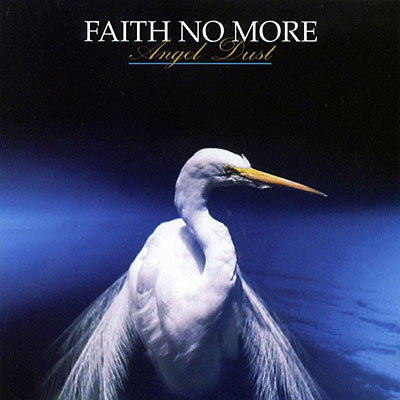
Aptly Named: "Angel Dust" Review

Album: Angel Dust
Artist: Faith No More

Genre: Avant-Garde / Experimental Rock
Length: 1:01:54
Release Date: June 8th, 1992
Label: Slash
Producer: Matt Wallace, Faith No More


Despite having just recovered from the rousing financial success of their 1989 release, The Real Thing, the wildly experimental rock group Faith No More denied the push for greater mainstream appeal, pulling a 180-degree turn and taking an entirely different approach to their sound. The result, Angel Dust, has proven to be one of greatest examples of success through experimentation and avant-garde mentality over stagnation and repetition.

It has also proven to be nuttier than peanut brittle.

Now, I’ve received some flak in the past for languishing on albums which hammer about on gimmicks and genre-benders rather than create a unique, self-proclaimed niche…not like I’m pointing fingers or anything [insert evil glare at Beck here]. At first glance, Angel Dust is nothing if not a “gimmick album”, sometimes completely hiding its hard rock foundations behind layers of bizarre genre insertions. Moments of thrashing metal or ballad-rock-esque riffage are certainly present, and indeed form the core of the Faith No More experience, but they tend to be masked by the outright twisted diversions the album often takes. Whether it’s cheerleaders chanting in the background of Be Aggressive, or the presence of sudden choir organs at the end of Jizzlobber (yes, Jizzlobber), there’s almost always something in each track meant to distract the listener from the band’s true roots. It’s often in these situations that I’m reminded of a magician performing a trick; it’s all about the spectacle and flair, meant to draw the eye (or, in the case of music, ear) from what’s really going on, never giving the audience a moment to wonder whether or not there’s any substance that lies behind the façade.

But in Faith No More’s case there is, and there are two simple reasons why: the risks they take are A.) justified, and B.) performed with elegance and class. You could certainly pick apart the album’s moments of mind-splitting, acid-tripping freak-outs and argue whether all of them are really necessary, but overall they tend to delightfully serve as means to an end, rather than the end itself. Take, for instance, one of the oddest of the bunch RV; here, multi-talented vocalist Mike Patton adopts the low-pitched, grumbling persona of a low-income, trailer-trash father, and describes – amidst the backdrop of a country-tinged guitar and fiddling piano – the utter amounts of sloth, stubbornness, and regret that define his pathetic life. You’re right to think that it sounds silly, and indeed the song will probably have you in stitches by the time Patton starts his lower-class rant about how his “pants fall down every time I bend over”, but there’s no denying it works. In addition to holding interest, this approach adds infinitely more credibility to the statement that the song is attempting to make about middle-America. Call it a gimmick, if you must, but while most gimmicks repel, this one sucked me in like a black hole.

Angel Dust is full of these brilliantly executed left-field moments, even in the times when the band is getting their rock on. Album opener Land of Sunshine is one of the more straightforward thrashers occasionally exhibited by the record, but when a series of descending keyboard notes give a dark, carnival-esque flavor to the proceedings, it makes even the straightforward seem intriguing and engaging. It even possesses some of the earliest proto-typical instances of rap meeting metal, lending to a nu-metal vibe that’s almost strong enough to promote mental images of Jonathan Davis and Fred Durst sitting outside the recording studio with a pen and notepad in hand, giggling wildly in hysteria. Other moments are simply, as the saying goes, “full of win”, such the track Crack Hitler (yes, Crack Hitler), which opens with guitar-scratching and funky bass so reminiscent of 80’s streetwise cop thrillers that it feels like it could be a suitable intro theme to Magnum P.I., or Midnight Cowboy, which is actually a cover of the theme of the 1969 drama film of the same name. And believe me, anything that could get to say words like this in a non-ironic manner is truly a few screws loose, if you catch my drift.

Of course – or at least as is my understanding – experimentation means nothing if the fundamentals aren’t in place, and Faith No More is at least competent in this area as well…unlike some people [insert evil glare yaddayaddayadda]. Patton’s aforementioned vocal talents are the strongest asset on display, capable of adapting to any needed role, from creepy whispers to fevered shouts to…yes, the rapping. The guitar tone and playstyle does not drift far from contemporary rock styles of the time, but it is executed with class, complexity, and even a few proggy outbursts. Interesting to note is that the bass and keyboards are practically just as prominent in the mix, if not more so, which lends a funky twist to the music. Surely, nothing about the music remains as interesting when the band’s experimenting gears aren’t spinning, but as far poppy, metal-tinged rock goes, it’s actually quite good in small doses, at least until the weirder stuff kicks in and things become deliciously haywire.

While this is certainly the magnum opus of Faith No More, and a prime example of how to properly create avant-garde music without complete failure, it is by no means perfect. In an album so rife with experimentation, it’s inevitable that some of them miss their mark with certain audiences; I, for one, did not gel with the rapping sections, though that may be because rap and metal usually mix about as well as pickled relish and raspberry jam. It’s also a tad on the long side, which may mean your interest may run dry over the course of a sustained listen. And indeed, as hinted before, one cannot shake the feeling that the underlying foundations aren’t nearly as stable without the extraneous layers to support it. And yet, for all its eccentricity, Angel Dust is still a work of art. With a bounty of clever ideas, thought-provoking lyrical themes, and even some catchy riffs here and there, it stands atop a pantheon of musical oddities to remain treasured as an influential classic. If nothing else, it’s good for at least one listen to absorb the kookiness that dwells within, as well as to affirm the idea that one does not need to be bland to be successful.

Monday, November 9, 2009

There is No God But God: "Those Whom the Gods Detest" Review

Album: Those Whom the Gods Detest
Artist: Nile

Genre: “Egyptian” Brutal/Technical Death Metal
Length: 56:39
Release Date: November 3rd, 2009
Label: Nuclear Blast
Producer: Neil Kernon, Erik Rutan


…and so I entered that tomb of blackened pitch, a hollow artifact of a lost age buried deep beneath the sands of time. My hands grip the sarcophagus that hath contain the powers of which I seek. Trembling, gripped by a nameless fear, I slowly lift the obsidian stone, my eyes both disturbed by and beckoned to the unseen horrors within. Slowly, shadow gives way to the light of Ra, and in so doing ushers forth sounds and images beyond this world, horrors once immersed only within the burning pits of the Duat. I draw nearer, draped in terror yet unable to escape my own temptations. The sounds grow louder, and more feverish, until at last the barriers that withheld this ancient power shatter and unleash a sonic scream unlike anything imaginable to mortals, man or beast.

Within this brewing wrath hath reside the might of a thousand sandstorms, the militaristic might of a million pharaohs, the infinite flames of a million demons spawned of Apep himself. Both gods and men, past and future, cower before it as it destroys all who dare stand before it. Louder it grows, more frenzied, and from within I hear a single isolated howl, a demon’s voice that exclaims, “KAFIR!”. I look upon the hands that unearthed this ravenous pestilence and, amidst the chaos, ask myself, “What hast thou done?”

I already knew the answer. I hath unleashed Nile upon the world.


* * *

If you’re a regular to the world of extreme, you’re probably more than familiar with the sublime death metal innovator that is Nile. For those unaware, Nile is a brutal death metal band led by songwriter/vocalist/guitarist/musical genius Karl Sanders, revolving almost entirely around Egyptian and other Mediterranean cultures. To this end, the riffs are written in a number of various Middle Eastern scales, modes and instruments, and feature lyrics inspired by Egyptian mythology and history, or even excerpted directly from ancient texts (or those of famous horror-writer H.P. Lovecraft). It’s a formula that has shaken the death metal world time and time again, establishing Nile as leaders in metal songwriting and atmosphere. Unfortunately, many fans (of which I am one, in case you hadn’t quick picked up on the subtle hints yet) were disappointed in their 2007 release Ithyphallic. Here, much of atmosphere and interesting instrumentation were gone in favor of straightforward thrashing, capped off by terrible production values and an album title that gave way to more than a few penis jokes. I remained convinced, in spite of doubts dwelling deep in the back of my head, that Ithyphallic was the one-time product of a lack of inspiration, and that the inevitable successor would restore the band to their former glory. I was right.

I just didn’t know how right I was.

Those Whom the Gods Detest is an absolutely astounding piece of death metal gold. It’s the product of a trio renewed in their convictions and driven by their passion to create music that is as overwhelming as it is enthralling. And that seems odd, because in a manner of speaking, TWTGD doesn’t strongly alter the classic Nile formula in any way. So what exactly has improved enough for me to name this the best Nile album in years? Well…pretty much everything.

For starters, the production values are the best Nile has ever had. Much hyperbole was made on the toiling of the producers to craft the best Nile sound yet for this album, and there is no doubt that they delivered. Sure, their previous works achieved a dark, muddy sound that matched the music note for note, but something, be it the guitars on Black Seeds of Vengeance or the vocals on In Their Darkened Shrines, always seemed to get buried. TWTGD performs a miracle by retaining that same grittiness as the previous albums while simultaneously making every performer come in clear, crisp, and above all, powerful.

It’s also notable that this is probably the most technically demanding Nile album yet…which is saying an awful lot. Sanders and Dallas Toler-Wade are, as always, demons behind the six-strings; the rapid-fire guitar pickings and haunting harmonics in “Permitting the Noble Dead to Descend to the Underworld” have to be heard to be believed. The duality between their vocals works better than it did on Ithyphallic as well, even if Toler-Wades straightforward bellows receive more of the spotlight than Snader’s otherworldly growls on this venture. If any one member of the trio deserves props for his instrumental performance on this album, however, it’s George Kollias, the drummer. He’s quickly making a name for himself as one of the best drummers in the modern metal world today, and TWTGD is the best proof of that. His spastic drum fills are always entertaining and expertly precise, but he won’t truly blow your mind until you hear him pounding away at the double-bass at up to 300 BPMs (!!!).

Of course, Nile has always been less about the technical aspects of their music (at least compared to other similar bands) and more about that classic atmosphere, the ability of their music to sweep you away thousands of years into the past and transport you into the world of ancient Egypt. Where the previous album managed to fail in that regard for the first time, TWTGD brings it roaring back. It’s not exactly dripping with the shadowy atmosphere and unpredictability of ITDS, but it always incorporates enough unique ideas into each song to make them all distinctive and memorable in that old, “Sanders” way. The indescribable riffs that open “Utterances of the Crawling Dead”, for example, seem to be perfectly emblematic of the howls of spirits from beyond the grave. The title track opens with whispered ritualistic chanting alongside the playing of a sitar-like instrument, luring the listener into a false sense of security…before leaping for the throat in what quickly becomes one of Nile most vicious, most evil “epic” tracks (clocking at around eight-minutes, yet remaining gripping to the very end). Instead of opting for a couple of slower, doom-based riff monsters, the band cleverly inserts some doom sections into several of the faster tracks, with the only “4th Arra of Dagon” serving as the slow, plodding giant of the album. There’s even a non-metal instrumental very much akin to Karl Sander’s solo projects, and it’s probably one of the better ones to appear on a Nile album, featuring a number of unique instruments and creepy, chanting vocals to sell the ambiance.

If there’s any one track that serves as a representative for Nile as a whole, let alone the album, it is the opener, "Kafir!" (the subject of my little Lovecraftian-esque fiction at the start of this review). Over the course of roughly six minutes, it incorporates both the fast-flying fury and the slow, crushing madness that Nile is known for. Most notably, before the amazing solo and as the song closes, "Kafir!" incorporates beautifully sung Islamic prayer; the theme of song being the nature of Islam itself. Nile’s lyrics have always been deep and insightful, not to mention a learning experience worthy of the Discovery Channel (you know you’re good at song writing when you make a song about a Hittite ritual performed with dog crap seem interesting…no, really), but it’s songs like "Kafir!" that provide a social relevance quite isolated to this album in particular. The title would suggest a clear stand against religion and deities as a whole, and that context is certainly implied, but in a subtle way; rather than outright state their disdain for established faiths, as many more bone-headed death metal bands may attempt, they use the examples of the ancient past to make their case. It’s clever stuff, to be sure, and the inclusion of liner notes explaining the history behind the music will help the people who, unlike Sanders, don’t have encyclopedic knowledge of Egyptian religious reforms...or don't know who the hell Ra or Osiris are.

As far as flaws go, they are fairly self-explanatory to anyone familiar with Nile. As I stated, the overall formula for the music has not changed much, but has only improved from that basis; if you didn’t like the band’s bizarre fusions to begin with, there’s little hope for you here. And of course, brutal death has always proven to be a tough sell outside of the underground, so the tone and subtleties I’ve outlined here may be completely lost on the people who can’t stand the sound of a good growl or double-bass section. That being said, if you have even the remotest interest in death metal and/or Egyptian culture, you should be listening to this album right now. It has far exceeded my expectations, and may one day be listed alongside Amongst the Tombs of Nephran-Ka and ITDS as one of their greatest works, not to mention one of the best death metal albums of 2009. Consider this an unflinching recommendation from somebody who rarely ever gives them.

...Full of Sound and Fury, Signifying Nothing: "Embryonic" Review

Album: Embryonic

Artist: The Flaming Lips

Genre: Alternative / Indie Rock

Length: 70:17

Release Date: October 13th, 2009

Label: Warner Bros.

Producer: The Flaming Lips, Dave Fridmann, Scott Booker


Double albums are a rare sight in the musical landscape, and with good reason. A certain set of associations and expectations are usually attached to works that get the double album “label”; we expect the long road to the album’s completion to be riddled with variety, spontaneity, and epic might, as to compensate for the many hours they extract from our lives. As far as my knowledge extends, no double album has ever reached these proverbial stars, and in fact they tend to almost always come crashing back into the ground; the band’s attempts to fit this mold are almost always the hurdles that make the album tedious or even unlistenable. To this day I still don’t know the ingredients necessary to craft a truly compelling double album, but at least I know that The Flaming Lips are just as clueless as I am.


…which isn’t to say that they don’t try, of course. Notable attempts have been clearly been made to alter the signature sound of this psychedelic indie rock band into something different for their latest opus, Embryonic. It is perhaps the “busiest” work they’ve performed, not in terms of technicality but in the stacked layers of various samples, keyboard drones, and other sci-fi miscellany compiled within each track. This, compacted together with unorthodox drum and guitar production values, does indeed craft something different; the problem is that it also comes across as over-produced and over-done. Explaining the cacophonous sounds portrayed by such songs as “See the Leaves” and “Watching the Planets” is difficult, and may need to be experienced first-hand. Beauty is in the eye of the beholder, after all, but in my eyes there is really no beauty here. Rather, when all of the various elements in each song collide, they most often react negatively and combust, destroying any chance at attaining the simplicity that might have been.


The complex, multi-layered style of the album almost seems to be compensating for the lack of actual dynamics within; strip away the random beep-boops, bells, and whistles, and you’ll find rather basic indie rock songwriting, with endlessly looped melodies and lyrics. This isn’t inherently a problem, mind you; many bands of this irk do not strive for detailed song-writing, but instead succeed in luring listeners into a sense of tranquility before enveloping them into a haunting, black void of calm. Unfortunately, The Flaming Lips spoil their chances at this form of success, too; even the most stripped-down, beautifully simple songs like “Evil” are poisoned by unnecessary sound bites haphazardly scattered into the mix, and by the end the listener is left with the distressing feeling that nothing was ultimately accomplished. With no chance to get lost in the music, nor much reward for paying close attention, there is little to reap from listening to Embryonic.


This missteps may have been forgivable if the album were a decent length, properly paced so that one could soak in the most memorable moments and have them still pulsing through the brain by the time the album accelerated to its climactic end. Here, my friends, is where the hideous double album demons rear their ugly heads, because the “epic” length utterly destroys this album. Without much in the way of variety or story progression to spice up the album or give it a theatrical punch, it devolves into what is essentially a marathon of tedium…and keep in mind that 70 minutes is actually pretty short for a double album! It begs the question, “Why didn’t they just cut out half the tracks and market it as a standard release?”


Well according to the band itself, the record was created in an attempt to solve their “dilemma” of what to include on each preceding album. They furthermore assert that the album’s creation was in debt older classics like The Beatles whose albums were decidedly “un-focused” and attempted a wide variety of styles.


This, handily, explains most of the issues I’ve pointed out up to now. Essentially, then, there is no over-arching theme or story to the songs at hand, but rather just a jumbled compilation of ideas, smashed together then split into two discs. Such is not the proper way to create an epic; such creations demand structure and coherence, something Embryonic clearly lacks. Even as a “variety sampler” I feel that it fails upright in the face of the band’s ambition. Not only do I not feel a sense of variety and open-endedness running through the album, but I also feel that its inability to strive for and achieve a certain goal dooms it from the beginning. As far as I’m concerned, there’s nothing wrong with being “focused”; it’s what has allowed many a band to become associated with certain emotions or themes. Embryonic, to me, leaves no lasting emotional impression of this sort; it’s as bland as un-buttered bread, and not nearly as delicious.