Showing posts with label rock. Show all posts

Tuesday, January 5, 2010

Aptly Named: "Angel Dust" Review

Album: Angel Dust
Artist: Faith No More

Genre: Avant-Garde / Experimental Rock
Length: 1:01:54
Release Date: June 8th, 1992
Label: Slash
Producer: Matt Wallace, Faith No More
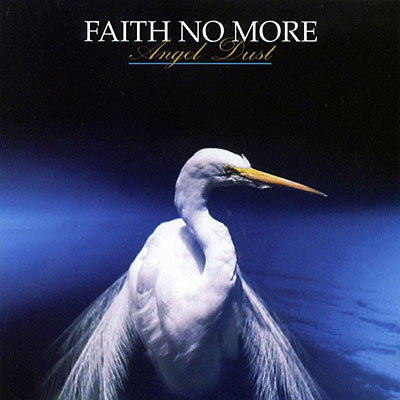


Despite having just recovered from the rousing financial success of their 1989 release, The Real Thing, the wildly experimental rock group Faith No More denied the push for greater mainstream appeal, pulling a 180-degree turn and taking an entirely different approach to their sound. The result, Angel Dust, has proven to be one of greatest examples of success through experimentation and avant-garde mentality over stagnation and repetition.

It has also proven to be nuttier than peanut brittle.

Now, I’ve received some flak in the past for languishing on albums which hammer about on gimmicks and genre-benders rather than create a unique, self-proclaimed niche…not like I’m pointing fingers or anything [insert evil glare at Beck here]. At first glance, Angel Dust is nothing if not a “gimmick album”, sometimes completely hiding its hard rock foundations behind layers of bizarre genre insertions. Moments of thrashing metal or ballad-rock-esque riffage are certainly present, and indeed form the core of the Faith No More experience, but they tend to be masked by the outright twisted diversions the album often takes. Whether it’s cheerleaders chanting in the background of Be Aggressive, or the presence of sudden choir organs at the end of Jizzlobber (yes, Jizzlobber), there’s almost always something in each track meant to distract the listener from the band’s true roots. It’s often in these situations that I’m reminded of a magician performing a trick; it’s all about the spectacle and flair, meant to draw the eye (or, in the case of music, ear) from what’s really going on, never giving the audience a moment to wonder whether or not there’s any substance that lies behind the façade.

But in Faith No More’s case there is, and there are two simple reasons why: the risks they take are A.) justified, and B.) performed with elegance and class. You could certainly pick apart the album’s moments of mind-splitting, acid-tripping freak-outs and argue whether all of them are really necessary, but overall they tend to delightfully serve as means to an end, rather than the end itself. Take, for instance, one of the oddest of the bunch RV; here, multi-talented vocalist Mike Patton adopts the low-pitched, grumbling persona of a low-income, trailer-trash father, and describes – amidst the backdrop of a country-tinged guitar and fiddling piano – the utter amounts of sloth, stubbornness, and regret that define his pathetic life. You’re right to think that it sounds silly, and indeed the song will probably have you in stitches by the time Patton starts his lower-class rant about how his “pants fall down every time I bend over”, but there’s no denying it works. In addition to holding interest, this approach adds infinitely more credibility to the statement that the song is attempting to make about middle-America. Call it a gimmick, if you must, but while most gimmicks repel, this one sucked me in like a black hole.

Angel Dust is full of these brilliantly executed left-field moments, even in the times when the band is getting their rock on. Album opener Land of Sunshine is one of the more straightforward thrashers occasionally exhibited by the record, but when a series of descending keyboard notes give a dark, carnival-esque flavor to the proceedings, it makes even the straightforward seem intriguing and engaging. It even possesses some of the earliest proto-typical instances of rap meeting metal, lending to a nu-metal vibe that’s almost strong enough to promote mental images of Jonathan Davis and Fred Durst sitting outside the recording studio with a pen and notepad in hand, giggling wildly in hysteria. Other moments are simply, as the saying goes, “full of win”, such the track Crack Hitler (yes, Crack Hitler), which opens with guitar-scratching and funky bass so reminiscent of 80’s streetwise cop thrillers that it feels like it could be a suitable intro theme to Magnum P.I., or Midnight Cowboy, which is actually a cover of the theme of the 1969 drama film of the same name. And believe me, anything that could get to say words like this in a non-ironic manner is truly a few screws loose, if you catch my drift.

Of course – or at least as is my understanding – experimentation means nothing if the fundamentals aren’t in place, and Faith No More is at least competent in this area as well…unlike some people [insert evil glare yaddayaddayadda]. Patton’s aforementioned vocal talents are the strongest asset on display, capable of adapting to any needed role, from creepy whispers to fevered shouts to…yes, the rapping. The guitar tone and playstyle does not drift far from contemporary rock styles of the time, but it is executed with class, complexity, and even a few proggy outbursts. Interesting to note is that the bass and keyboards are practically just as prominent in the mix, if not more so, which lends a funky twist to the music. Surely, nothing about the music remains as interesting when the band’s experimenting gears aren’t spinning, but as far poppy, metal-tinged rock goes, it’s actually quite good in small doses, at least until the weirder stuff kicks in and things become deliciously haywire.

While this is certainly the magnum opus of Faith No More, and a prime example of how to properly create avant-garde music without complete failure, it is by no means perfect. In an album so rife with experimentation, it’s inevitable that some of them miss their mark with certain audiences; I, for one, did not gel with the rapping sections, though that may be because rap and metal usually mix about as well as pickled relish and raspberry jam. It’s also a tad on the long side, which may mean your interest may run dry over the course of a sustained listen. And indeed, as hinted before, one cannot shake the feeling that the underlying foundations aren’t nearly as stable without the extraneous layers to support it. And yet, for all its eccentricity, Angel Dust is still a work of art. With a bounty of clever ideas, thought-provoking lyrical themes, and even some catchy riffs here and there, it stands atop a pantheon of musical oddities to remain treasured as an influential classic. If nothing else, it’s good for at least one listen to absorb the kookiness that dwells within, as well as to affirm the idea that one does not need to be bland to be successful.

Monday, November 9, 2009

...Full of Sound and Fury, Signifying Nothing: "Embryonic" Review

Album: Embryonic

Artist: The Flaming Lips

Genre: Alternative / Indie Rock

Length: 70:17

Release Date: October 13th, 2009

Label: Warner Bros.

Producer: The Flaming Lips, Dave Fridmann, Scott Booker


Double albums are a rare sight in the musical landscape, and with good reason. A certain set of associations and expectations are usually attached to works that get the double album “label”; we expect the long road to the album’s completion to be riddled with variety, spontaneity, and epic might, as to compensate for the many hours they extract from our lives. As far as my knowledge extends, no double album has ever reached these proverbial stars, and in fact they tend to almost always come crashing back into the ground; the band’s attempts to fit this mold are almost always the hurdles that make the album tedious or even unlistenable. To this day I still don’t know the ingredients necessary to craft a truly compelling double album, but at least I know that The Flaming Lips are just as clueless as I am.


…which isn’t to say that they don’t try, of course. Notable attempts have been clearly been made to alter the signature sound of this psychedelic indie rock band into something different for their latest opus, Embryonic. It is perhaps the “busiest” work they’ve performed, not in terms of technicality but in the stacked layers of various samples, keyboard drones, and other sci-fi miscellany compiled within each track. This, compacted together with unorthodox drum and guitar production values, does indeed craft something different; the problem is that it also comes across as over-produced and over-done. Explaining the cacophonous sounds portrayed by such songs as “See the Leaves” and “Watching the Planets” is difficult, and may need to be experienced first-hand. Beauty is in the eye of the beholder, after all, but in my eyes there is really no beauty here. Rather, when all of the various elements in each song collide, they most often react negatively and combust, destroying any chance at attaining the simplicity that might have been.


The complex, multi-layered style of the album almost seems to be compensating for the lack of actual dynamics within; strip away the random beep-boops, bells, and whistles, and you’ll find rather basic indie rock songwriting, with endlessly looped melodies and lyrics. This isn’t inherently a problem, mind you; many bands of this irk do not strive for detailed song-writing, but instead succeed in luring listeners into a sense of tranquility before enveloping them into a haunting, black void of calm. Unfortunately, The Flaming Lips spoil their chances at this form of success, too; even the most stripped-down, beautifully simple songs like “Evil” are poisoned by unnecessary sound bites haphazardly scattered into the mix, and by the end the listener is left with the distressing feeling that nothing was ultimately accomplished. With no chance to get lost in the music, nor much reward for paying close attention, there is little to reap from listening to Embryonic.


This missteps may have been forgivable if the album were a decent length, properly paced so that one could soak in the most memorable moments and have them still pulsing through the brain by the time the album accelerated to its climactic end. Here, my friends, is where the hideous double album demons rear their ugly heads, because the “epic” length utterly destroys this album. Without much in the way of variety or story progression to spice up the album or give it a theatrical punch, it devolves into what is essentially a marathon of tedium…and keep in mind that 70 minutes is actually pretty short for a double album! It begs the question, “Why didn’t they just cut out half the tracks and market it as a standard release?”


Well according to the band itself, the record was created in an attempt to solve their “dilemma” of what to include on each preceding album. They furthermore assert that the album’s creation was in debt older classics like The Beatles whose albums were decidedly “un-focused” and attempted a wide variety of styles.


This, handily, explains most of the issues I’ve pointed out up to now. Essentially, then, there is no over-arching theme or story to the songs at hand, but rather just a jumbled compilation of ideas, smashed together then split into two discs. Such is not the proper way to create an epic; such creations demand structure and coherence, something Embryonic clearly lacks. Even as a “variety sampler” I feel that it fails upright in the face of the band’s ambition. Not only do I not feel a sense of variety and open-endedness running through the album, but I also feel that its inability to strive for and achieve a certain goal dooms it from the beginning. As far as I’m concerned, there’s nothing wrong with being “focused”; it’s what has allowed many a band to become associated with certain emotions or themes. Embryonic, to me, leaves no lasting emotional impression of this sort; it’s as bland as un-buttered bread, and not nearly as delicious.

Saturday, October 17, 2009

Enjoy the Show: "Sergeant Pepper's Lonely Hearts Club Band" Review

Album: Sgt. Pepper's Lonely Hearts Club Band
Artist: The Beatles

Genre: Psychedelic Rock / Pop
Length: 39:42
Release Date: Jun 1st, 1967
Label: Parlophone / Capitol
Producer: George Martin


As I readied to start writing reviews again, I was hindered by the thought of what, exactly, should mark my re-entry. What album could I analyze that would conjure images of the epic and the daring, that would brew up the storms of controversy I tend to be well known for? After much pondering and consideration, however, the answer stood before me, intimidating and daunting: I would return to the roots. Not those of my own, mind you, but music itself; to the heart of the beast, the lifeblood that pumps inspiration through the veins of the pop industry. I would travel back in time to the 60s, when the new body of music arose from behind a shroud of marijuana smoke.

This is my greatest stand. This is my darkest and lightest hour both. This is my review of Sergeant Pepper’s Lonely Hearts Club Band.

But first, allow to quickly establish my position on The Beatles, if I may: contrary to popular belief, I don’t actually hate them. In fact, prior to this review, I knew nothing more of them than what has become public common knowledge. What I do hate, of course, are the fans, the cult birthed in the wake of their reign that sets out to make any accomplishment in music pale before the veil casted by their four gods. To this today I find the prospect of any band being the “one true master” to be absolutely ridiculous. Does it not divert the eyes of humanity away from new accomplishments in favor of those which have already happened? Does it not defy the concept of music being an abstract concept which can satisfy equally in more forms than one? This is what I despised, and yet to prove them wrong I would have to defile their sacred idol, to destroy that which they pray to. I would have to prepare an assault on what many call the greatest album of all time, Sergeant Pepper’s Lonely Hearts Club Band.

So…let’s get started.

In my mind, it’s easier to summarize SPLHCB not by what it is, but what it isn’t. What it isn’t is the greatest album of all time, the sacred, untouchable masterpiece that it so consistently is made out to be. It isn’t flawless, it isn’t seamless, and it isn’t exactly “pure” (in the sense that one might expect the pinnacle of music to be an unmitigated product of the human soul rather than the by-product of substance usage).

And yet (and this is where it gets shocking, I know) I was quick to discover that it also isn’t bad. In fact, it seems to me more accurate to label the album not as the top of the musical pedestal, but the bottom: the foundation upon which nearly everything that followed it built up from. It has goals, and achieves them; it takes risks, and they work. It’s the jack-of-all-trades of the music world, a work that excels at little yet accomplishes much.

Really, on a technical and compositional level, there isn’t much to say about SPLHCB that hasn’t already been said. The sound of The Beatles, love it or hate it, is iconic, and all of the elements that form its compound are present here in full swing. The swooning vocal melodies, the air of psychadelia, the almost “bouncy” (if somewhat dull and unimpressive) drum beats of Ringo Starr…it’s all here. Many of the songs featured here are at the height of fame and public knowledge, particularly “Lucy in the Sky With Diamonds”, and yet I don’t think the album operates solely on a song-by-song basis. It’s the little moments that create SPLHCB, from the almost comedic background noises of the title track to the Indian, tribal vibes of “Within You Without You” to the sweeping orchestral elements of “She’s Leaving Home”. The Beatles pioneered the use of new effects and complex arrangements on this album, and when it shows, it also shines; the bizarre and darkened orchestral moments that are interspersed throughout the otherwise happy and cheery “A Day in the Life” are almost haunting, finishing off the album on a high note by ironically sounding at its lowest. The weakness of the album, in my mind, is that it too often limits its ambition and devolves into simple minded pop (or, in the case of songs like “When I’m Sixty-Four”, the style of musicals…bleh). The aforementioned tracks stand out the most in my mind because they represent that which The Beatles have come to: change, the introduction of new ideas to old formulas. It’s a shame, really, that the pop industry as a whole has come to recognize the more bland entries of SPLHCB as models to follow.

That the album has stood the test of time for so many individuals surprises me, because within minutes I could see the tears in the stitches that hold this album together. For one thing, as a lyrical piece, the whole thing doesn’t hold up. The myriad drug references are cute at best, and everything else ranges from the average to the nonsensical (the words to “Being for the Benefit of Mr. Kite” were adapted almost word-for-word from an old circus poster…no, really). It isn’t exactly a masterpiece of instrumentation either, nor is it trying to be (though I must say the sudden guitar solo towards the end of “Good Morning Good Morning” was as decent as it was surprising). I just find it amusing that it has gone on to inspire thousands upon thousands of untold artists with nothing more than the beating of its own proverbial heart. There isn’t a single thing about the album that gave it such power; The Beatles just wrote a set of songs, and fate worked out the rest. For anyone to try to duplicate what they did would end in failure as assuredly as someone attempting to find two snowflakes that look exactly alike.

Perhaps I am not the one to talk about pointlessness; after all, look what I’m trying to critique here. Chances are, you, the reader, have already heard enough of The Beatles to know whether or not you follow their religion. I write this regardless, however, to dispel the myth that The Beatles are beyond criticism. As a matter of fact, nothing is; there will be no golden album, descending from the heavens, that every single individual on Earth will treat indisputably as the second coming. Flawlessness is a hypothetical concept; for everything else, flaws exist that can be criticized. Critics exist to project their own satisfaction or dissatisfaction upon the world, regardless of popular opinion; even if, in their unified voice, a single decision reigns most powerful, there can one, if only barely audible that chooses another.

I am that one voice. I am here to say that Sergeant Pepper’s Lonely Hearts Club Band is a good album. Not perfect, but good, or rather the essence of good. I can see how it is qualified as the measuring stick with which to weigh pop music, but certainly not all music, and certainly not how it is held with the highest possible regard.

Yet that I am able to respect it at all humbles me. In my travels towards that blackened heart, I discovered more than I anticipated. There are some good songs here, products of a band that worked well together (well, sometimes anyway) with a taste for many flavors of the musical spectrum. In my opinion, it isn’t the greatest in the way that most people say…but it is the greatest at something, and that is more than I ever imagined it would be.

Sunday, December 7, 2008

The Cold Places of the Universe: "The Moon and Antarctica" Review

Album: The Moon and Antarctica
Artist: Modest Mouse

Genre: Alternative / “Indie” Rock
Length: 59:43 (72:02 reissue)
Release Date: June 13, 2000 (March 9, 2004 reissue) (2008-09-12)
Label: Epic
Producer: Brain Deck (Simon Askew reissue)


Somewhere in the life of every successful and long-lived group of musicians comes a time when they must make a crucial choice; to vegetate in the same style they have developed and loved from the beginning, or to take the deep risk of mending and experimenting with it. By the former path, bands may stagnate to the point of irrelevancy; by the latter, they risk alienating the fans of all that had come before and thus put their reputations on the line. And by the excessive degree to which fans can take hold of a particular band, seeing them either change or rot away is often an unbearable transition. Such results in a polarized following, one side composed of former disciples who swear by the old works battling against another of those who jumped on the bandwagon with the new. And in the process, it’s the band themselves who end up in the crossfire.

Enter Modest Mouse, the indie darling sextet that has earned accolades and praise amongst underground critics since 1993. In recent years, the band has begun to stir up fury within the more experienced loyalists as they have made the transition into mainstream attention (if somewhat limited in scope). Suddenly the band who had once recorded an EP in a garage had hit #1 on the Billboard 200 with 2007’s We Were Dead Before the Ship Even Sank, and those who felt the band had sold its soul were out for blood. Its such massive transitions that make one question the nature of past albums, as its sometimes possible to trace the gradual evolution of the band into the states they finally arrive in. Such was the purpose when I – a veteran of perhaps the most heated fan-war stalemate of all time, the on-going In Flames debate (though that it is a story for another time) – was parachuted deep into the strife to review Modest Mouse’s supposed magnum opus, The Moon and Antarctica, to see how it held up outside of a fan perspective.

Now as far as I can understand, The Moon and Antarctica was the band’s attempt to expand off the broad base cemented by their previous breakthrough release, The Lonesome Crowded West. Blame the experimentation on either a desire for greater variety or Isaac Brock’s broken jaw if you will, but ultimately for every critic who showered the album in gold stars there was another who thought Modest Mouse was edging into commercial territory; quite frankly, when a band starts licensing songs to Nissan Quest minivan commercials it can be difficult to think otherwise. Yet I can’t help but feel like the commercialization argument has gone the way of a horse that has been beaten one too many times; the glossier production values and major label status aren’t necessarily strikes against TMaA, merely differences. In fact, they often help amplify the more spacious, spacey sound the album develops, which in the land of the Indie City resides on the corner of Mature Street and Engaging Avenue, only occasionally striding into Pretentious Lane to pick up its groceries. To put it in a much less metaphor-laden way, it’s as good a representation of the indie scene as your going to find this side of the decade.

Indeed, the band’s attempts to tinker with their formula resulted in making it much more distinct. The blend of classic folk, alternative song structure and delightful synthesizing in a powerful one indeed that will usually leave the listener immersed up to his or her eyeballs. Though it doesn’t offer too much room for technical chops, that’s hardly what the record is about. Instead, it’s quite keen to manipulate this mellow, laid-back foundation into a variety of different moods throughout the setlist, from sullen and plodding (Perfect Disguise) to bouncy and joyful (Life Like Weeds), and even moments where these moods are exchanged frequently (3rd Planet). The twangy guitar-sound does, however, remain roughly the same throughout, which makes most songs blend together. It also makes the longer tracks like The Stars Are Projectors outlast their welcome, even if the addition of some moderate tempo changes does manage to shake things up. Fortunately, plenty of other moments, like the swooping keyboard dips and dives in Dark Center of the Universe and the surprisingly aggressive opening to A Different City, stand out.

Strangely, the member of the group whose contributions I am least enthusiastic for is the one who practically drives the band, Isaac Brock. His singing style is very unique, for sure, but it sometimes stands in stark contrast to everything else in a song, and eventually becomes rather grating as the album wears on. He’s more of an acquired taste than anything, and due to the aforementioned broken jaw his appearances are actually somewhat limited by alternative standards, so for most it won’t even be a factor. Yet I also have a bone to pick with the lyrics; a lot of people cite them as being exceptionally clever and insightful, and I would agree to an extent, but simply can’t muster the same enthusiasm. Most are open to interpretation – hardly an issue on its own – but without some kind of binding context, many of them could be about…well, anything. Not to mention that many tracks take it into themselves to repeat the same redundant lines several times over; if you don’t know what it means the first time, the next few times will only be bound to reinforce that notion. With enough studying, however, some personal meaning for each song should fall right into place (*winkwink*) for you. Oh, and a special shout-out has to be made to Wild Packs of Family Dogs, which put the dainty little images of dogs eating people and “crying dust blood” into my mind’s eye. A happy album, this is not.

By this token, TMaA personally falls into the little niche of strong, yet sometimes flawed, curiosities. While there are plenty of nitpicks to be made, the overall sound of the album is powerful enough to warrant praise without trespassing previously tread territory – the very definition of a successful experiment. This was certainly not a diversion to be forgotten, either, as traces of the more airy, calmer sound still exist in the songs of newer fare from the band. And for those out there hooked on the atmosphere but not the presence of Mr. Brock, this album will likely provide your best escape. Respectable lyrics and a moody environment combine to make TMaA worthy of attention, both back in 2000 and now.

So what have I now to say to the fanboys of each faction of the Modest Mouse debate? Well to be honest, I probably didn’t even need to hear the album to tell all of them to stop their futile actions before they all give themselves brain hemorrhages. To the newer recruits, I sayeth now that TMaA is a fine album that needs no disrespect, even if you prefer the more widely known, two most recent releases. I have even less comforting things to say to the other group, who will simply have to deal with whatever changes the band has felt are best for them, be it for reasons of nobility or greed. In either case, the past is irreparable, and in this case for the better.


P.S. : Apologies about the delay. My computer seems to have attained some kind of nasty Adware virus that’s slowing down my entire computer, and even preventing me from using some programs whatsoever. I’ve been trying to work my way around it, and hopefully my computer will be clean and running at full speed again by next week.

Saturday, November 22, 2008

A Totally Serious Review, I Swear: "Appeal to Reason" Album Review

Album: Appeal to Reason
Artist: Rise Against
Genre: Melodic Hardcore / Punk Rock
Length: 48:23
Release Date: October 7, 2008 (2008-09-12)
Label: Geffen
Producer: Bill Stevenson and Jason Livermore


When I got asked to review a Rise Against album, I ran back home and grabbed my iron helmet and wooden shield, because I was about to run the gauntlet. Rise Against hails from the same line of punk-rooted protest bands that have been running rampant across corporate America ever since the Bush administration started shooting itself in the foot (that’s 2,345,670 bullets fired into the big toe and counting!) and there’s hardly a demographic I hate more; the smug half-baked philosophy, the restless complaining, the same four or five chords and drum beats recycled over and over and over until you want to run for Congress, work your way up the ranks, and finally submit and authorize a bill that forbids the little pricks from coming within 500 miles of freedom. So Rise Against had the tall order of trying to change my cold, steel-plated cynical beast-mind into thinking they could possibly be any different. The result…

…is that they totally did. Wow. I couldn’t have believed it until this album had arrived before me, but I was wrong about the entire pseudo-punk movement from day one. In fact, Rise Against is the most valuable of music bands because it taught me an amazing lesson: that you can sell five figures within the first week of a release and even have your own line of shoes purportedly manufactured by slave labor and still pretend to be a pot-smoking, Molotov-tossing anarchist rebel. How inspiring!

The magic begins with Collapse (Post-Amerika), which in no way resembles anything ever done before, not even American Idiot...hell, not even themselves on past albums. The single-tempo, emotionless riffing, and generic hardcore shouts would sound utterly monotonous and repetitive from any other band, but Rise Against makes them work. How? Alas, their genius is far too much for me to describe in simple man-words. And behold, for when the next track begins, so does the exact same pattern and song structure! Such is their brilliance that they repeat the exact same formulaic compositions a grand total of 13 times…and with 13 being an unlucky number, the act serves as flawless testament to their bravery. Only rarely do actually interesting leads or notable bass lines ever appear to fuck things up, but the producers were so brilliant as to edit them out to their last breath as not to spoil the perfection. The lone exception to this ever-so original formula is an acoustic song entitled Hero of War, so originally titled and so not made up from the remnants of discarded Bob Dylan B-sides that it would make the likes of Leonardo da Vinci and Wolfgang Mozart cry. Why, so great is this beautiful track that it could very well rise those fallen geniuses from the dead, officially making Tim McIlrath the second-coming of Jesus Christ. No wonder so many people rabidly worship these awe-inspiring musical heroes!

But if there is any reason to bow down before the likes of this ground-breaking band, it is their lyrics, whose majesty and truth ring like the bells of Heaven’s highest, most ornamented towers. They speak of a terrifying fascist government that will in no way disappear a mere three months after this album’s release date, and one that has in no way been spoken of by any other musical act. Nope, not even Green Day. And how, you may be wondering, can such beaten-to-death lyrical clichés such as “fall[ing] from grace”, “desperate eyes”, and “the strength to go on” possibly combine to make these inspiring call-to-arms messages? Again, I could not possibly explain it, but totally not because they couldn’t. Because they could. In fact, they do it so well that they don’t even need to create solutions to the political problems they so desperately claw at like merciless, blood-thirsty kittens. Thus, these songs will ring throughout the back alleys of all the greatest organizations of protest and resistance, such as Hot Topic and McDonalds, from now until the end of mankind. Only the greatest musicians could create music as such that it will never become dated, certainly not in, as aforementioned, three months from now. You know, when the man they are trying so hard to condemn is replaced by a liberal reformist who the country so strongly supported in a fairly recent election. Oh no, certainly not then.

And so I sayeth to you, in the spirit of the mightiest revolutionaries of our time – from Lindsay Lohan to Justin Timberlake – let your voices of pre-pubescent confusion and conformism be heard by purchasing this downright irreplaceable masterpiece. And as you half-heartedly pound your fist in the air, pretending to fight an evil that has already been fought by people whose actions actually matter and whose criticism is not just limited to needless whining, remember that you support a band whose music is definitely not just a clone of a million other bands who came before, whose imagery is completely and totally unique, and who honestly, undeniably, unsarcastically, doesn’t suck balls.

Sunday, November 2, 2008

Sunshine, Lollipops, and Backstabbing: "Rumours" Album Review

Album: Rumours
Artist: Fleetwood Mac

Genre: Classic Rock
Length: 40:03
Release Date: February 4, 1977
Label: Warner Bros.
Producer: Fleetwood Mac, Ken Caillat & Richard Dashut


Perhaps you haven’t yet heard the little fable that goes along with Rumours, an album that ranks among one of the best-selling and most critically-acclaimed of all time. As the story goes, every one of the band’s five members was going through a romantic issue of some kind during the song writing process, prominently involving break-ups between the band members themselves (Lord only knows why any of them thought that an inter-career love interest would be a good idea). Subsequently, as each one started independently crafting lyrics for the next album it became apparent that they were all writing about each other, hence the album’s name. In the end, the realization that their deep, burning hatred for one another had resulted in what they considered a good piece of music somehow alleviated the tension, and everybody was happy. Rainbows were painted into the sky by magic purple unicorns while Stevie Nicks and the gang soared into the glorious sunset on their fantastical enchanted sailboat to buy delicious ice cream. THE END.

Now, all of that makes for a decent marketing blurb or at least a notable Wikipedia factoid, but it doesn’t confirm or deny the presence of actually decent song-writing on here. As it turns out, one of the features of this album that seems to stem from that little feud is neither a strength nor a weakness, and that’s in how divisive the songs are from one another. With all but a scant few tracks being almost entirely associated to a single individual, most of them tend to exert a slightly different feel from the rest, usually by highlighting certain elements while removing others. Compare the bouncy acoustic-driven tune Second-Hand News to the slow piano-laden ballad Songbird, for instance, and you’d hardly think there was any relation. The since-beaten-to-death prospect of having two vocalists of varying Y-chromosome levels furthers the idea by rarely having the two work in tandem, either by awkwardly switching between them or by omitting one or the other from a track altogether. Granted, you can interpret the frantic switches of style as either a lack of balance or an abundance of variety, so for the most part it won’t detract from the experience if you listen to the album on a song-by-song basis.

What does detract from the experience are some rather boneheaded and suitably predictable song-structures that prevent it from being elevated to the highest levels of the art form. Most tracks have respectable core ideas but attract clichés like bears to honey-covered babies, namely in the basic verse-chorus architecture that occupies the majority of the album. And if the aforementioned back-story implied to you that the lyrics, fueled by friction and hostility, would be very intricate or unique, then you may want to get your head re-examined. The mainstream music industry’s attempts to flirt with truly deep reflections on love-once-lost are almost always utterly horrific, and a quick flip to your local radio station is usually enough to prove it. And while the Fleetwood gang’s assortment of poems are hardly as bad as the modern dribble that passes for music, it’s hardly art, which is something you might expect from the sort of Shakespearian-tragedy the band members went through. There are exceptions, but perhaps not enough to list “lyrical and structural ineptitiude” as some of the album’s flaws.

So yes, Rumours does suffer a bit for being the product of a band under duress and, more importantly, for being draped in the clothing of commercialism despite the cries of its subject matter to represent quite the contrary. Yet despite all the hateful things I’ve managed to point out so far about it, there is a certain aura around Rumours that is – dare I say it? – oddly compelling.

For all the angst and bitterness you might expect to come from such a strained group of individuals, Rumours has to be one of the most overtly optimistic albums I’ve ever heard. Songs like Dreams and Gold Dust Woman provide a bright outlook for dreary events through their lyrics, which are just as linear as aforementioned, but the music itself is what makes the album such a shining beacon of hope. Whether it’s the jazzy bass-lines of You Make Loving Fun (just ignore the cheese-flavored title, please) or the deliciously folksy Never Going Back Again, the actual music is genuinely good at generating happiness, which is something I thought I’d never say about any piece of music, ever. If you can ignore the majority of what comes out of their mouths, the two singers reflect this good-spirit just as well, and ignoring what I said about the awkward transitions between them, both Lindsey Buckingham and Stevie Nicks have phenomenal voices. It’s when things start to get a bit more layered, when the talents of all the band members are proficiently and simultaneously shown such as in The Chain, that the album’s coherent weaknesses can be overshadowed by these strengths…which is kind of ironic, if you think about it.

All in all though, my reaction is mixed. It’s no doubt an album that treads the fine line between accessibility and complexity, and while it leans into both categories at some point or another there’s a lot about the album that feels rather indecisive and conflicting, fittingly enough. Altogether the songs sound a lot better when less focus is put into analyzing them as a musical depiction of themes and worse when framed into the context of being technical and elaborate, as I have the rather obsessive habit of doing. That being the case, you get out of Rumours what you put into it. Walk in expecting a casual, colorful romp into floaty and loose song-writing and you’ll walk out believing that this really was worthy of all its fame; listen to it expecting brilliance and you get a kick in the face. If the former is what you expect, or in fact need, from your music, then you could certainly do a lot worse than Fleetwood Mac’s Rumours.

Sunday, October 5, 2008

Great Gig in the Sky, Indeed: "Dark Side of the Moon" Review

Album: The Dark Side of the Moon
Artist: Pink Floyd

Genre: Progressive Rock / Psychadelic Rock
Length: 42:59
Release Date: March 17, 1973
Label: Harvest (1973), Capitol (20th Anniversary), EMI (30th Anniversary)
Producer: Pink Floyd


It’s a sad fact of life – at least in the world of music, anyway – that the greatest and most important creations and developments are often sadly overlooked. I can expect anyone to know who Britney Spears is, but I still get raised eyebrows when I ask someone about Iron Maiden, and I guarantee most people have no idea what a “Grandmaster Flash” is. In such a world, it’s become increasingly difficult for me to take anything that’s remotely popular or mainstream seriously, which has in part lead to my more “alternative” taste.

Pink Floyd’s The Dark Side of the Moon is, in all respects, a glorious exception to this rule. Once my initial skepticism was pushed aside, I was overjoyed to find it to be one of the elite few truly deserving of its success and praise. And that goes beyond its purely financial achievements; at the time of its conception, DSotM was (and I am not exaggerating in the slightest here) an album destined by its inherent brilliance, creativity, and originality to define its era and deeply influence those to come from here to eternity. Whether that’s a statement that everyone wearing the Pink Floyd T-shirts they bought at The Gap can agree with is beyond me, but against impossible odds the fans and the critics – myself included – seem to agree, and so should you.

What’s truly magnificent about Pink Floyd is that the fame they acquired was due solely to the music they created, as it should be. DSotM is probably the best of their works to represent their ability because it is simultaneously their most experimental, so much so that it went on to define a genre that revolves around experimentation: progressive rock. Unlike their later rock opera classic The Wall, the album wallows in a sort of ethereal state, passing fluidly from one phase to the next, hard to grasp yet impossible not to be sucked into, like a musical vacuum. For this reason it’s hard to definitively break down DSotM into parts and infinitely easier to look at it as a whole, where the division of the album into songs only exists to divvy up the conceptual lyrics.

And conceptual the album is, dealing with some of the broadest and most complex issues: life, death, and that which takes place in between. Speak to Me / Breathe is the embodiment of life, represented by the throbbing heartbeat that ushers in the album, and the brief Eclipse ends it with a bold statement about free will. The remaining songs cover all kinds of territory ranging from religion (The Great Gig in the Sky) to greed (Money) to ethics and moral conflict (Us and Them), and are all delivered beautifully through David Gilmore’s spectacular vocals.

The guitarists and drummers do their task marvelously throughout, never overly technical and always in sync with the rest of the sound, but the real star here is the keyboard, courtesy of (recently deceased) Richard Wright. They are, indisputably, the key that unlocks the album’s almost ghost-like and oftentimes eerie sound, and this is clearly the album to which Wright contributed the most. Apart from that, the album’s atmosphere is accentuated by masterful mixing in of various sound effects and other oddities. The exact reasoning escapes me, but when a metronome syncs perfectly with the starting riff in Time, or when a melody of ringing cash registers and jingling coins kick in Money, it seems to make the song more meaningful.

Of course, the album does have its flaws. If you haven’t inferred this by now, know that it takes a patient and open mind to fully enjoy what DSotM has to offer. For something that has garnered so much attention, it’s surprisingly slow and lacks the focus and immediacy of most other music; many of its greatest second-long moments have buildups that can take minutes, as is the nature of progressivism. On the Run symbolizes this well; its long and repetitive keyboard noodling, accented only by odd sounds that pass in and out, may be as exciting to some as it is coma-inducing to others. Ironically, another potential fault can be found in its ending, which is sudden and lacks the explosive punch you would expect such an epic album to end at. In most other regards, though, DSotM is excellently paced and mastered.

Of course, maybe I’m being overly analytical (not like that’s a surprise to anyone). Bluntly put, The Dark Side of the Moon perfectly captures the time and place of 1973, perfectly summarizes a handful of life’s most vital aspects, and is a blast to listen to, all in one handy package. Beyond being the most important proof that music that impresses the public and leaves a massive mainstream mark is almost always made without the intention to do so (see also: Nirvana), its an album that actually received what it deserved. It’s a pity more albums don’t.

And R.I.P. Richard. We think you and your band may have written your own best eulogy for you: "And I am not frightened of dying, any time will do, I don't mind. Why should I be frightened of dying? There's no reason for it, you've gotta go sometime."